Let me give you the numbers before I give you the opinion, so you can decide how much the opinion is worth. Over 24 months, starting from zero, we sold $25 million of real estate in the Dominican Republic. Not fundraising — houses sold to people who wired money and moved in.
We did it with three salespeople, a proper IT and AI stack behind them, and zero brokers.
Not out of principle. I started the way everyone starts. I went to brokers first — they were supposed to know the market, hold the buyers, close the deals. That’s what they’re for. That’s what the entire industry is organised around. It didn’t work. So I stopped, and built the sales organisation myself. This is an article about why, and about what three people with the right tooling can now do to an industry that employs hundreds of thousands.
The thing I actually discovered
The easy version of this article is “brokers are lazy and overpaid.” That isn’t what I learned, and it isn’t true — plenty of brokers are sharp, hard-working people. What I learned is structural, and it’s worse than laziness.
Real estate is a horizontally integrated industry, and sales is the one function you cannot safely outsource.
Look at how the business is actually built. Surveyors do land. Developers do buildings. Brokers do sales. Rental managers do rentals. Portals do listings. Each expands geographically, doing one slice in more places, almost never integrating vertically. It’s the default shape and nobody questions it.
Peter Thiel made the observation that the great value creation of the last 250 years came overwhelmingly from vertically integrated companies — Standard Oil, Ford, Apple, Tesla. Real estate is the loudest counterexample of an industry that refuses to learn it. The exception proves the case: Irvine Ranch, one vertically integrated project in Orange County, became one of the largest real estate developments in American history.
So when I outsourced sales, I wasn’t buying expertise. I was cutting my company in half and handing the half that touches the customer to people whose incentives were not mine.
What outsourcing sales actually cost me
Here’s what that looked like in practice, before I stopped.
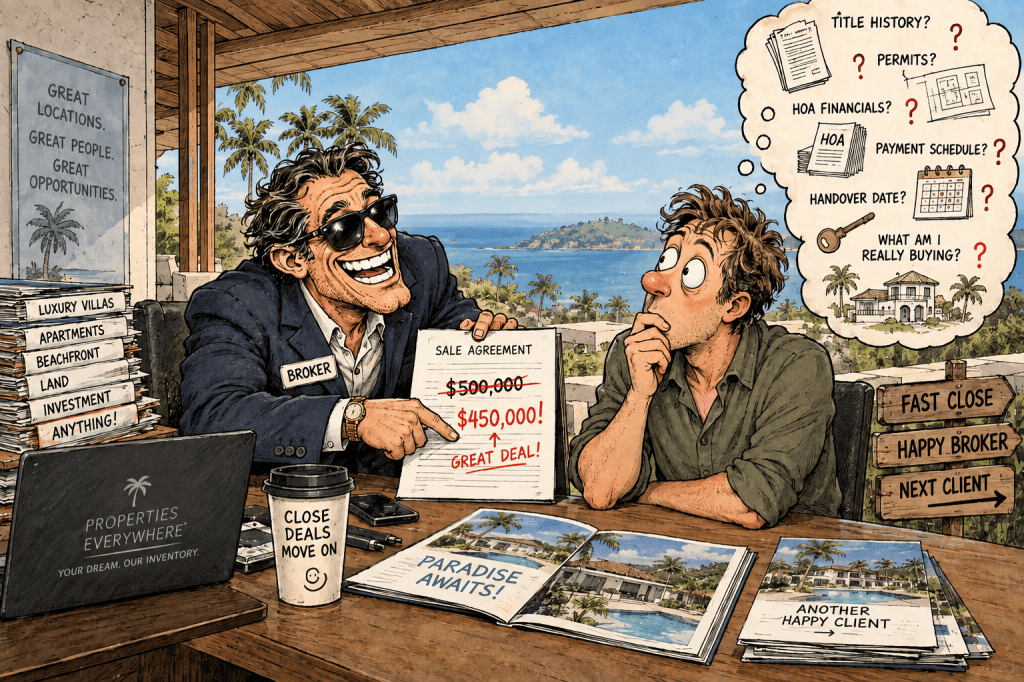
The buyer arrived knowing nothing. People would show up at the notary’s office to sign for a house without understanding the payment schedule, the HOA structure, the handover date, or what they were actually buying. Not because they were careless — because nobody had told them. The broker’s job ended at “interested,” and everything after that landed on us anyway, late and under time pressure.
Nobody checked anything. Ask about title history: “the notary will handle that.” Ask about permits: “that’s the developer’s responsibility.” Ask whether they’ve read the HOA financials: “What’s that?” These were people moving half-million-dollar assets while doing less verification than someone buying a used bicycle. When your own name is on the building, you learn very fast that “the notary will handle it” is how a project dies.
Every deal became a discount conversation. A broker’s fastest route to a close is a lower price — it costs him a few percent of one commission and saves him weeks. It costs me the price point of an entire phase. Our interests diverged at precisely the moment the deal got difficult.
The buyer relationship was never mine. This is what actually changed my mind. The lead, the conversation, the trust, the follow-up, the data — all of it lived in someone else’s CRM, someone else’s phone, someone else’s head. I was building a town and renting the relationship with the people who would live in it.
And I never got the feedback. Hundreds of conversations happened about my product and I heard none of them. Which objections repeated. What people asked about first. What made someone walk. That’s the most valuable information a developer can own, and I was paying a commission to have it thrown away.
Why the model does this — it isn’t personal
None of the above requires anyone to be a bad person. It’s arithmetic.
A broker is paid by the seller at closing, with no exposure to the outcome. That single sentence generates every behavior above. Speed beats accuracy. Volume beats depth. A closed deal that goes wrong in year three costs him nothing.
Volume and diligence compete for the same hours. Every transaction is a fixed number of days — showings, calls, paperwork, notary. Nobody closes ninety deals a year and reads ninety sets of HOA financials. “Top producer” isn’t a quality signal; it’s a confession about where the hours went.
And the real business isn’t selling your property — it’s holding every property. Breadth is the asset. Once a broker has enough inventory across enough price points, every person he meets becomes monetizable: the cousin looking for a rental, the client who wants something cheaper, the dinner guest going through a divorce. Nobody ever has to be turned away, so no relationship is ever wasted.
Perfectly rational. Also completely orthogonal to selling your specific house. Your listing isn’t a mandate he’s working; it’s a slot in a catalogue, and its job is to make the catalogue look complete. If it sells, excellent. If it doesn’t, it already did its job the day it was signed — it made him look like a man who has everything.
You thought you hired a salesperson. You donated a product line.
What changed when we brought it in-house
Not theory. This is what the $25 million was actually made of.
The person selling knows how the thing is built. Our team answers questions about foundations, permits, drawdown schedules or the drainage study without phoning anyone, because they work in the company that did those things. Buyers don’t get reassurance — they get answers. That converts.
We can say no. When a buyer is wrong for the project, or the financing doesn’t work, we say so and walk away. That’s an unthinkable sentence for someone paid on commission. It’s also the fastest way to build a reputation in a small market where everybody talks to everybody.
We don’t discount, we prepare. We tell people about delays, financing gaps and realistic timelines before they sign, not after. Deals start slower and far more survive to completion — the only number that matters, because a signed contract that collapses at tranche three is worse than no contract.
We own the asset. The database of verified, region-specific buyer leads belongs to the company. It compounds. Every campaign makes it bigger; every project sells into it faster. Three years of outsourced sales would have left me with nothing but a permanent rental agreement on access to my own market.
Every objection flows back into the product. What buyers hesitate over now shapes design, pricing and what we build next. That loop is closed. It leaked for years.
Three people did this. That’s the part that should worry the industry.
I want to be precise about why three salespeople could sell $25 million, because it isn’t that they’re superhuman. It’s that almost everything a broker actually does all day is now software.
Lead capture, scoring and routing. Follow-up sequences that never forget and never get discouraged. Campaign targeting across three continents. Call preparation, transcription and summarisation. Document generation. Pipeline forecasting. Answering the same forty questions in six languages at two in the morning. Every one of those used to be a person’s job, or a large part of one, and every one of them is now a system that costs less than a junior salary and doesn’t take Sundays off.
What’s left after the software has taken its share is the part that’s genuinely hard: judgment, local knowledge, verification, and sitting across a table from someone making the largest purchase of their life. Three people can do that for a hundred families a year. Three people cannot generate 25,000 qualified leads by hand — but they don’t have to any more.
I’ve been saying since 2017 that if you make your living sitting in front of a computer as an employee, you are exposed. I said it because I spent that year running deep learning systems that predicted customer behaviour for airlines and e-commerce, and I could see what the technology was going to eat. It was one of the reasons I moved out of software and into hardware — land, concrete, buildings.
The real estate broker is the purest example of the exposed job I was describing. An intermediary whose product is information, matching and follow-up, protected from competition by a licence rather than by the difficulty of the work. And now ask yourself why this profession, specifically, fought portals, then fought commission disclosure, and now writes op-eds about how algorithms “can’t replace the human touch.”
Technology doesn’t threaten good brokers. It threatens opaque ones. Every tool that makes pricing legible, inventory searchable or fees visible removes somewhere to hide a margin. When the answer to a transparency tool is “buyers need guidance,” translate it: buyers need not to see this.
The strongest argument against me
I have to concede this one, because it’s true and dodging it would be dishonest. Bringing sales in-house is expensive and slow. It cost me two years, a marketing function, a CRM and automation stack, and a lot of money spent learning things brokers already knew. Most developers cannot do this. Many shouldn’t try.
Because developers are, as a class, catastrophic at sales and marketing. They’re builders. They think in concrete, permits and drawdown schedules. Ask a developer to write a landing page, run a lead pipeline or pick up the phone on a Saturday and you’ll watch a competent man dissolve. The broker didn’t invade real estate — he filled a vacuum the construction industry created and still refuses to fix.
So the honest version of my argument isn’t “brokers are useless.” It’s this: the distribution problem is real, and outsourcing it to someone paid by the close is the worst available solution to it. That function belongs inside your company, or beside it with your incentives — not sold to you by the transaction.
So why is the profession still here?
If the model produces these outcomes, and three people with good tooling can replace a floor of agents, why does the broker exist in the volume he does? Because it’s licensed. Not because it’s useful — because it’s protected.
Licensing is sold as consumer protection. Look at what it actually protects. A financial adviser who gives bad advice is fined, sanctioned, sometimes barred. A surveyor who signs off on a plot he never walked commits malpractice and his insurer pays. Show me one licensing authority anywhere that forces a broker to refund a commission on a deal that failed for reasons a competent check would have caught. I’ll wait.
Unlimited upside on the close, zero exposure on the outcome, and a licence at the door keeping the number of people enjoying that arrangement conveniently finite. That isn’t a gap regulators haven’t got round to closing. That’s the product the licensing system was built to deliver.
Which is why my position isn’t that the profession should be banned. It’s that it should be delicensed — strip the protected monopoly, let anyone who can genuinely help a buyer compete for that buyer’s money, and let the license-holders find out whether the market wants what they sell.
If you want to know what replaces the licence, it’s what disciplines every adjacent profession: be paid by the side you represent, carry insurance against your own errors, and publish your miss rate. Surveyors do it. Auditors do it. Engineers do it. Do those three things and no licensing board is necessary, because you’ve swapped a barrier to entry for actual accountability. The licence protects the broker. Insurance and a published error rate protect the buyer.
America already ran this experiment
If this still reads like one developer’s grievance, look at the largest real estate market on earth.
In 2024 the National Association of Realtors settled antitrust litigation for roughly $418 million and agreed to dismantle the rules holding the commission structure together: buyer-agent compensation came off the MLS, and written buyer agreements became mandatory before showings.
Sit with what that means. The industry’s central mechanism — the seller quietly setting and advertising what the buyer’s agent would be paid — was indefensible enough to be traded away rather than tested in court. The cartel settled rather than explain itself. That’s not my opinion of the model. That’s the industry’s revealed opinion of itself.
Two conclusions
If you’re a developer: the function that touches your buyer is not overhead to be outsourced. It’s the half of your company where the relationship, the data and the pricing power live. It cost me two years to learn that. It sold $25 million.
If you’re a buyer: ask one question before taking anyone’s advice about a property. Who pays you, and when? If the answer is “the seller, at closing,” you haven’t found an adviser. You’ve found a salesperson — a perfectly respectable thing to be, as long as everyone says so out loud.
And if you’re a broker reading this and you’re furious: good. Show me the last three deals where you read the HOA financials before your client signed. Not the marketing deck. The financials.
If you can, I’ll print a retraction with your name on it. If you can’t, I’ve made my point.


Leave a Reply