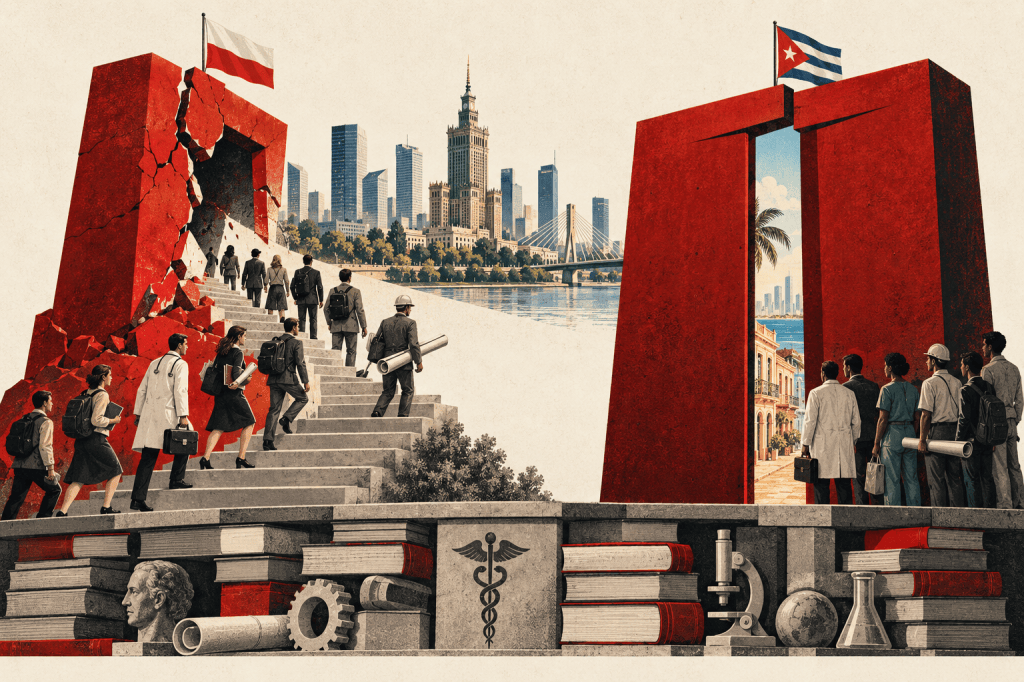
What forty-five years of central planning left behind, why it mattered after 1989, and whether the same pattern could make Cuba one of the fastest-growing economies of the next three decades
I am Polish. I grew up in the shadow of the system I am about to discuss, and I built companies in the market economy that replaced it. So let me say first what this article is not. It is not a defense of communism. The system was repressive, it wasted enormous amounts of capital, and it kept millions of people poor for decades. Anyone who lived in it knows that.
It is an argument about something narrower and more uncomfortable: the system left behind assets that the market economy later put to work. Poland’s success after 1989 is usually told as a story of reform, discipline and EU money, and all of that is true. But reforms need people who can respond to them. I believe the least discussed ingredient in Poland’s rise is that a generation of Poles arrived at the starting line literate, schooled and healthy enough to run, with a very clear view of how far ahead their neighbors were. If that is right, the same pattern may be visible today 90 miles from Florida.
Where Poland started
It helps to remember how low the starting point was. The 1921 census found that 33.1% of Poles over the age of ten could not read, with the worst figures in the former Russian partition. A Polish historical study notes that even on the eve of World War II, close to one citizen in five was still illiterate. Income was just as far behind: according to World Bank economist Marcin Piątkowski, from the 17th century until very recently Poland’s GDP per capita almost never exceeded half of the Western European average.
Then came the war, which destroyed much of the prewar intelligentsia through Nazi and Soviet killings and emigration. The communist government that took over in 1945 faced a country with few teachers, few professors and a large rural population with little schooling.
What the system built
Schools
The People’s Republic ran a national literacy campaign from 1949 to 1951 and declared illiteracy defeated when it ended. Free and compulsory schooling, new state-funded universities and a large increase in the number of teachers followed in the 1950s. By 1956, according to a Central Statistical Office study cited in the literature, every physically and mentally healthy Polish child was receiving an education.
The motives were not pure. A Polish archival study of the campaign concludes that the authorities were driven mostly by the wish to widen the reach of ideological indoctrination, and Lenin’s slogan that “Socialism cannot be built by illiterates” was quoted in the official materials. The motive does not change the result. A farming country became a literate, industrial one within a generation.
Health
Here the honest picture is more mixed, and it is worth being precise. The state provided universal access to medical care and trained a large workforce of doctors and nurses. But outcomes stalled: Polish life expectancy rose quickly until 1966, then fell for men and barely moved for women until 1991. The real gains came after communism ended. Between 1990 and 2023 life expectancy rose from 71.2 to 78.6 years, driven largely by falling cardiovascular mortality. My reading is that the communist system built the clinics, the medical schools and the habit of universal access, and the market economy, better diets and modern treatments then delivered the results.
What happened when the system ended
The numbers after 1989 are among the best in modern economic history.
- Poland has grown without a recession since 1992, and it was the only EU economy to avoid one in 2008–2009.
- GDP per capita at purchasing power parity rose from roughly USD 11,900 in 1991 to roughly USD 45,100 in 2024, about 3.8 times higher, according to World Bank data.
- Between 1990 and 2015 nominal GDP per capita rose 7.3 times, the largest increase in the OECD over that period. Hungary’s rose 3.7 times and Bulgaria’s three times.
- Piątkowski calculates that since 1995 Poland has been the fastest-growing large economy in the world among countries at a similar level of development, ahead of South Korea, Singapore and Taiwan.
No single factor explains this. EU membership in 2004 and structural funds contributed roughly half a percentage point of annual growth, by one estimate. Early stabilization and privatization mattered. But so did the people. Poland did not have to teach a nation to read in 1990. It had engineers, technicians, nurses, tradespeople and a population that could use a telephone, fill in a form and learn a new job.
Hunger, envy and a market next door
There is a softer ingredient that is harder to put in a table: ambition. By the 1980s Poles could see how people lived in West Germany and Austria, through relatives who had emigrated, seasonal work abroad, television and trade. The gap was visible and personal. When the border opened and the market arrived, a literate, healthy and impatient population moved fast: it started businesses, retrained, moved abroad for work and often came back with capital and ideas.
I would call this a demonstration effect, and it is an interpretation rather than a measurement. I think it matters. Educated people who know exactly how much better life can be, and who suddenly have permission to try, behave differently from people who have never seen the alternative.
Demand mattered too. Poland has nearly 38 million consumers, sits next to the world’s largest single market, and joined it in 2004. A well-educated workforce with low wages and a huge market within trucking distance is what attracts factories, services and investment.
Now look at Cuba
Seen through the same lens, Cuba has a surprising number of the same ingredients.
Start with literacy. Poland had eliminated illiteracy by the 1950s, and Cuba reports 99.75% adult literacy (UNESCO, 2012), the second highest among the countries surveyed. On health, Poland in 1989 offered universal access to care and a life expectancy of about 71, while Cuba today has a life expectancy of 78.4 years (2025), against 74.0 in the Dominican Republic. Both also had a rich neighbor. Poland had West Germany and Austria, and later EU membership in 2004. Cuba has the United States, 90 miles away, with more than 1.3 million Cuban-born residents (2019). Diaspora capital follows the same pattern: Poland had large emigrant communities in Germany, the US and the UK, while Cuba receives remittances estimated at USD 2 to 3.5 billion a year, and in March 2026 Havana announced that Cubans abroad may own businesses on the island. The domestic market is where Cuba is weaker, with about 10.9 million people and falling, against about 38 million in Poland. Finally, there is the private sector. Poland’s reforms began in 1989–1990, and in Cuba private firms now account for more retail sales than state enterprises, but only about 15% of GDP.
Cuba’s human capital is real. The country trains doctors on a scale far beyond its size, and around 20,000 of them were working abroad at the start of 2026. Cubans also share Poland’s 1989 hunger: they know exactly what Miami looks like, and many have relatives there. The Dominican Republic next door has a GDP per capita (PPP) above USD 30,000 and a quarter of Cuba’s population emigrating would be enough to fill many of its resort jobs. Everything a would-be Cuban entrepreneur wants to compare is a short flight or a WhatsApp call away.
The starting line is lower than Poland’s
It would be dishonest to skip the present. Cuba’s economy is in its worst condition in decades. The UN Economic Commission for Latin America and the Caribbean reports that GDP fell 3.8% in 2025 and projects a further 6.5% fall in 2026. AFP reports that output has dropped about 11% over five years. Blackouts have repeatedly shut down the national grid, the loss of Venezuelan oil and tighter US measures in early 2026 deepened the fuel shortage, and the population is shrinking through emigration. One Cuban observer summed up the outlook for 2026 as “hard, very hard.”
Data on Cuba is poor. The IMF does not publish a comparable GDP series for it. Estimates of GDP per capita range from about USD 1,100 at the official exchange rate (CEPAL, 2025) to about USD 9,600 in an older World Bank figure. Whichever is closer to the truth, Cuba starts far below Poland’s 1991 level of roughly USD 11,900 in PPP terms, and the economy is contracting.
Could Cuba really become the richest country in the world?
This is the bold part of the thesis, so let me do the arithmetic openly. The richest economies today have incomes of roughly USD 140,000 per person in PPP terms. Starting from the most generous estimate for Cuba, around USD 12,300 (a 2016 figure that is now too high), reaching that level in 30 years would require real growth of about 8% every year, and closer to 10% if the leaders keep growing at 1.5%. Starting from the CEPAL figure, the required pace is well above 15%.
For comparison, Poland’s celebrated catch-up averaged about 4% a year in PPP terms from 1991 to 2024. Cuba would have to roughly double the pace of the fastest-growing large economy in recent European history for three decades straight. A handful of economies, mostly in East Asia, have sustained rates near that for a generation. None has done it from a base that is contracting.
So I will call the headline what it is: a bet, not a forecast. The more defensible version is that Cuba has the raw material to become one of the fastest-growing economies in the Americas once its conditions change, and that the upside in a full opening is far larger than almost anyone prices in. A country that goes from 11% below its 2019 output to the level of its Caribbean neighbors would already be among the great growth stories of the century.
What would have to change is clear from Poland’s experience:
- Secure property rights and an independent legal system, so that savings and investment are safe.
- A working currency and a banking system that people use.
- Reliable electricity and fuel.
- Normalized relations with the United States, so that the neighbor becomes a market and an investor instead of an obstacle.
- A real role for the diaspora, whose capital, skills and networks played a part in many catch-up stories.
- An outside anchor that disciplines policy. Poland had the EU. Cuba’s equivalent would have to be a trade and investment framework with the US and the region.
The case against this thesis
A serious version of this argument has to deal with its critics, and they have strong points.
- Causation is hard to prove. Poland was already investing in schools after 1918, and literacy was rising before the war. Many countries without communism also expanded education after 1945. Communism may have accelerated the process rather than created it.
- The quality of the human capital is disputed. A study by Beirne and Campos found that official human capital figures for communist countries were overstated compared with what their inputs would predict. Research by Brunello, Crivellaro and Rocco finds that older men educated under communism at primary and secondary level were penalized in the new labor market, although those with post-secondary education earned better returns than comparable Western Europeans.
- Health outcomes stalled. As noted above, Polish life expectancy stagnated for 25 years under communism and improved only after it ended.
- Cuba lacks Poland’s institutions. Poland changed its political system, joined the EU and moved to market rules at the same time. Cuba has opened only partly, and a 2026 decree reportedly pushes private firms into associations with state entities. Critics argue that without political change no major investor will commit.
- The causes of Cuba’s decline are contested. Supporters of the Cuban government blame the US embargo and the 2026 oil restrictions. Critics blame central planning, low productivity and a military-run conglomerate that dominates the best sectors. Most economists see both factors at work, and they disagree sharply about their relative weight.
- The skills are leaving. Mass emigration means that the educated population which makes the thesis attractive is the same population that is leaving.
What I take from it
I do not think the lesson is that planned economies work. They do not, and Poland’s growth since 1992 is the best evidence. The lesson is that human capital is the slowest asset to build and the one that outlasts the system that built it. When the system failed, Poland still had millions of people who could read, count, repair, teach and trade, and who badly wanted the life they could see across the border. The market economy put those people to work.
Cuba has the people and the ambition. What it does not yet have is the system that lets them use it. If that changes, even partly, the growth that follows could surprise the people who today consider the country a lost cause. If it does not, the most valuable thing Cuba owns will keep leaving on boats and planes. That is the reason the question is worth asking.




Leave a Reply