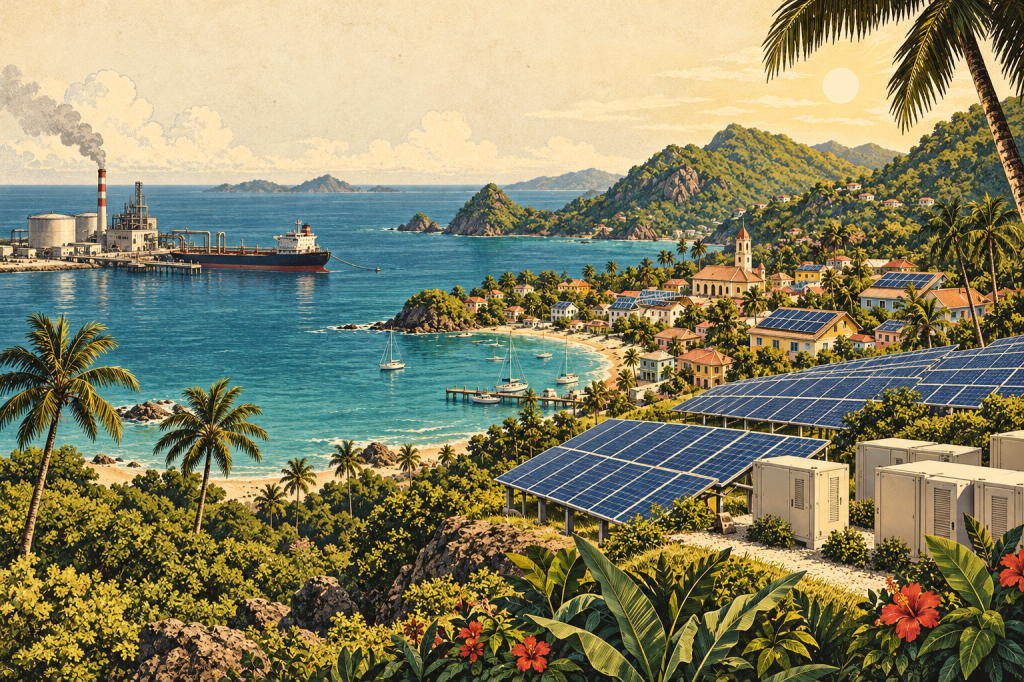
Imagine running a business where your biggest cost is something you cannot produce, cannot predict, and cannot negotiate. Every month a ship arrives, the invoice is set by a market on the other side of the world, and you pay it. That is how most of the Caribbean keeps its lights on.
I invest and build in the Dominican Republic, so I watch this closely. Electricity is not a side topic here. It decides what a hotel costs to run, whether a farm can pump water, and whether a family pays rent or a power bill first. Below I pull together the original data behind the story: Ember’s October 2026 analysis, plus the primary sources it rests on (IRENA, the World Bank, national tender documents, and the countries’ own climate pledges).
1. Nine percent
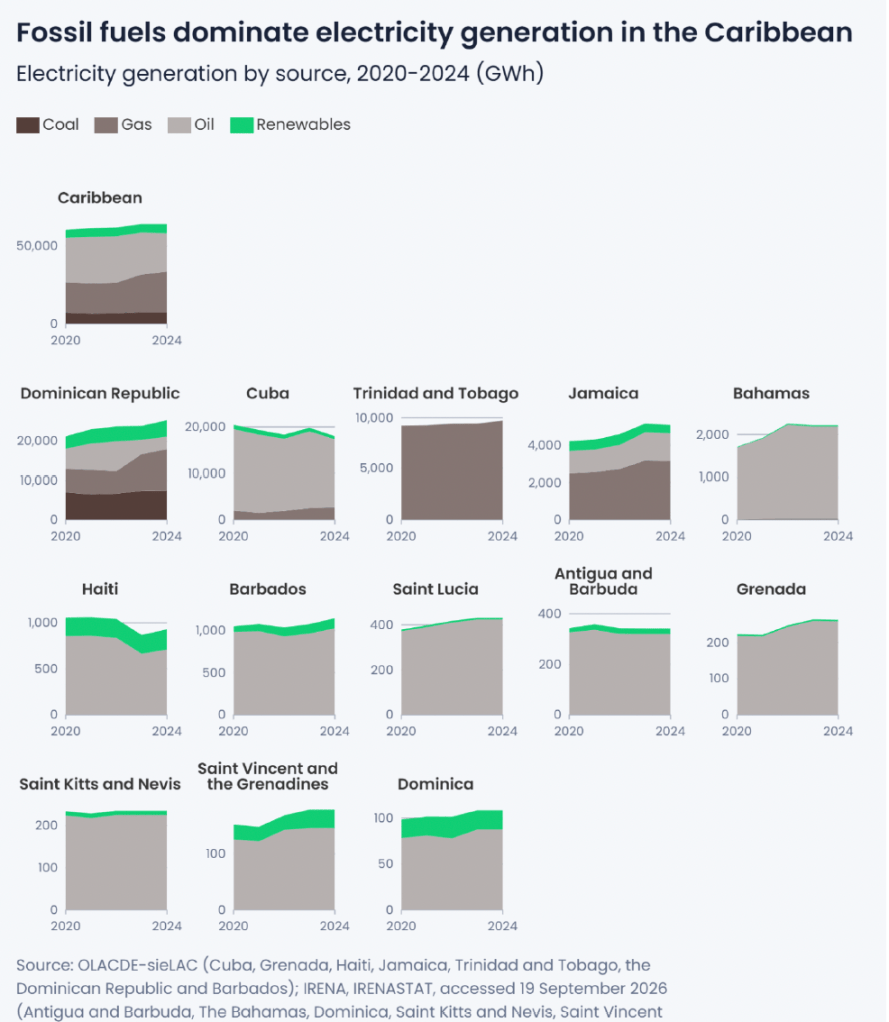
Across the 13 Caribbean countries covered, fossil fuels produced 90.9% of electricity in 2024. Renewables produced 9.1%. The world average is about 32%. Gas and oil each supply close to 40%; the islands are not coal economies, they are imported liquid fuel economies, which is the most expensive way to make a kilowatt-hour.
Sources: OLACDE-sieLAC and IRENA (IRENASTAT) via Ember, “Renewable Caribbean” (Oct 2026); world figures from Ember, Global Electricity Review 2025.
2. The invoice nobody puts on a billboard
Electricity is only part of the bill. Add transport and cooking fuel and the picture gets heavy. Using World Bank data, fuel imports in 2023 were about 9.5% of GDP in Jamaica, 8.5% in Dominica, 8.0% in Grenada and 7.3% in Barbados. The world average is 3.2%. The Dominican Republic sits at 4.4%.
When that much of national income leaves every year to buy something you burn once, it is not an energy problem. It is a balance-of-payments problem, a currency problem and a budget problem wearing an energy costume.
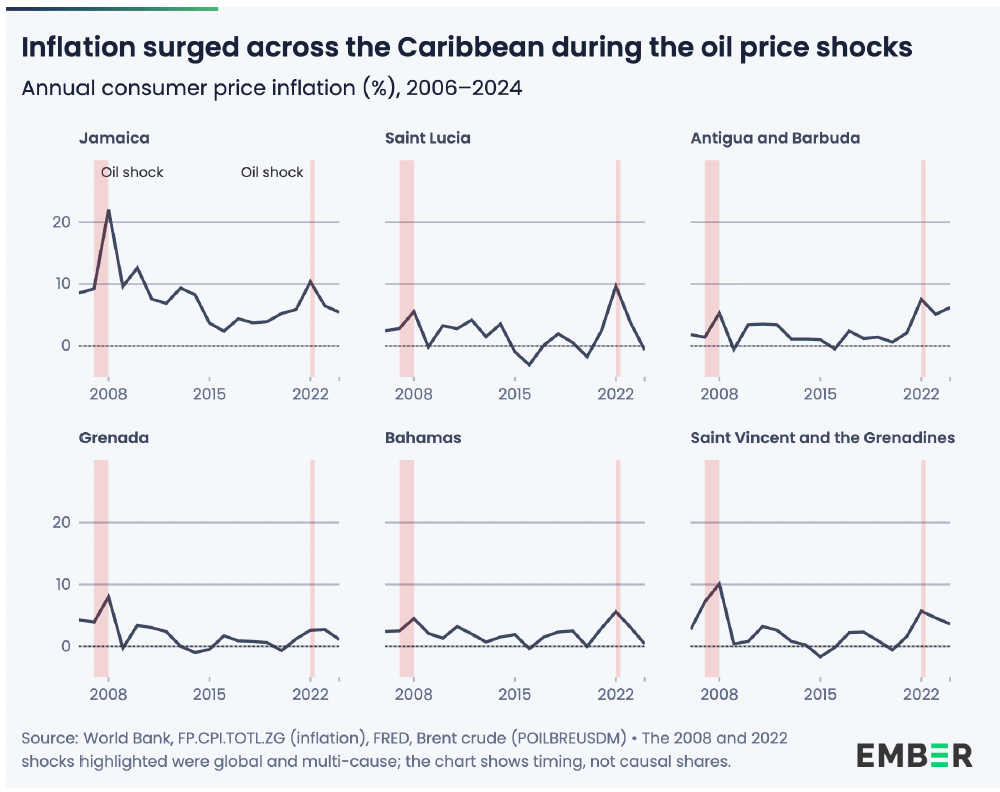
Source: World Bank, World Development Indicators (fuel imports as % of merchandise imports, merchandise imports and GDP in current US$), calculated by Ember. Only seven of the 13 countries have stable data.
3. When buyers actually compared prices, renewables won
Two recent contracts make the point better than any slogan.
- The Bahamas, Great Exuma. Power purchase agreements reported by The Nassau Guardian put solar at 11.48 US cents per kWh against 23.3 cents for LNG. The LNG price is 10.48 fixed plus 12.84 that moves with fuel every month. The solar contract has no batteries, so it is not like-for-like with firm power, but the gap is a lot to explain away.
- Dominican Republic, June 2026. The CNE and CUED awarded 325.69 MW of renewables with 50% battery storage at 10.60 to 10.90 US cents per kWh. Ember cites an average of 14.9 cents paid to generators in 2025. That is a price a regulator can defend to voters.
Jamaica tells the same story. Its competitive bidding produced solar and storage offers at roughly six to seven US cents per kWh. The lesson is simple: competition is the technology. The panels were always cheap enough. What was missing was a buyer who made sellers fight for the contract.
Sources: Bahamas Power purchase agreements (BPL and Exumas Renewable Energy Corp.) as reported by The Nassau Guardian; Dominican Republic CNE/CUED award announcement, June 2026; 2025 average price as cited by Ember.
4. Targets are free. Delivery is not.
Every government in the region has a pledge. Six of them are specific enough to measure. St Kitts and Nevis promised 100% renewable electricity by 2030 and sits at about 4%. Antigua and Barbuda promised 86% and is at 6.7%. Jamaica promised 50% and is at 8.9%. Saint Lucia (40%) is at 2%, Trinidad and Tobago (30%) is at roughly zero, and Cuba (26% by 2035) is at 3.7%.
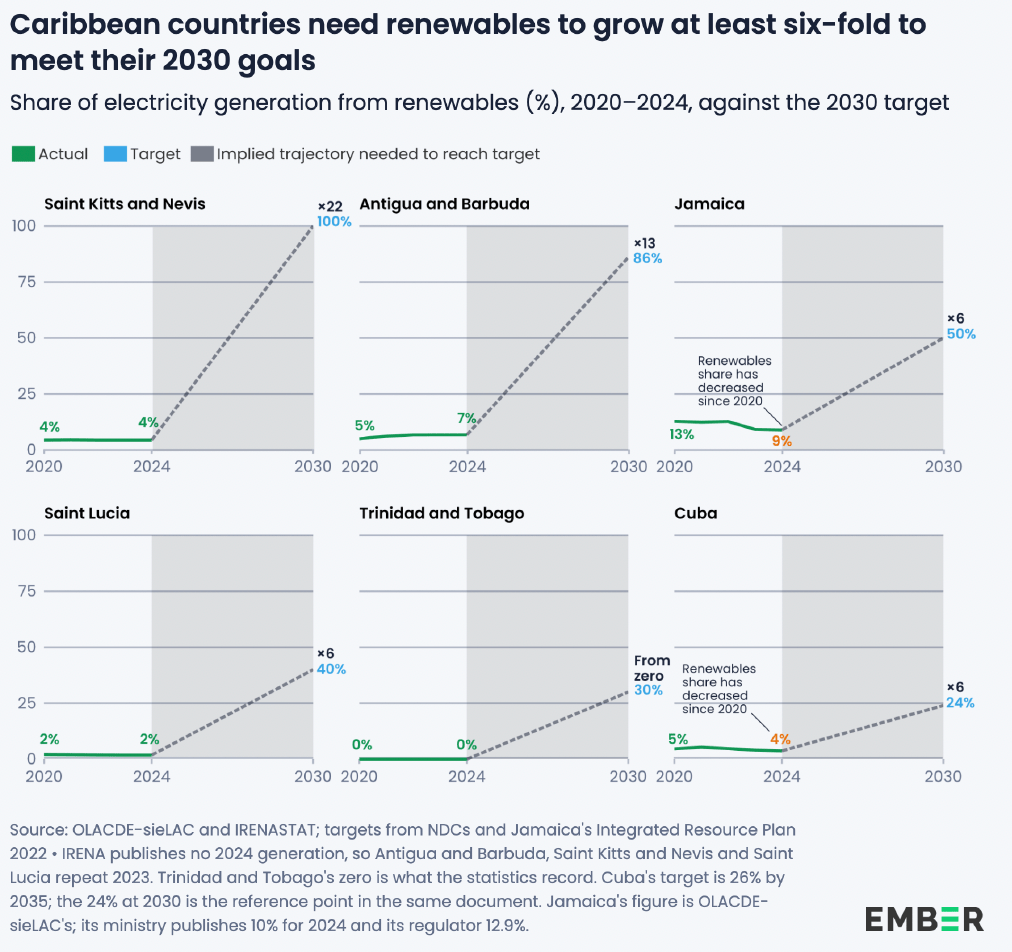
A target without a mechanism is a press release. I have sat in enough boardrooms to know the difference between a goal and a plan: a plan has an owner, a date and a budget line.
Sources: Nationally Determined Contributions registered with the UNFCCC and national plans (Jamaica IRP 2022); 2024 shares from OLACDE-sieLAC and IRENASTAT via Ember.
5. The solar nobody counted
Here is the twist. Households and businesses are not waiting for governments. Chinese solar panel shipments to the 13 countries went from 337 MW in 2021 to 1,809 MW in 2024 and 2,174 MW in 2025. Applying Ember’s assumptions, around 2,280 MW of solar was installed between 2021 and 2024, but only 1,269 MW appears in official capacity statistics.
In the Dominican Republic the estimate is 1,614 MW installed against 1,037 MW registered. In the other eleven countries (excluding Cuba) it is 454 MW against 55 MW. Rooftop solar is happening off the books, which means grid operators are planning blind, and policymakers are underestimating how fast the shift is already moving. Cuba is its own case: registered capacity rose 59% while solar generation fell 26%.
Sources: Ember, China Solar PV Export Explorer (imports; 73% assumed installed after a six-month lag); IRENA, Renewable Capacity Statistics 2026. Estimates as published in Ember, “Renewable Caribbean” (Oct 2026).
6. What worked, and what quietly failed
- Dominica brought geothermal online, using the one resource a volcanic island has in abundance.
- Jamaica and the Dominican Republic ran tenders and published the results. The prices above came from that discipline.
- Antigua and Barbuda passed a strong law, but a law on paper is not a megawatt on the grid.
- Trinidad’s Brechin Castle solar farm was built without batteries, which limits what it can do for the grid.
- Barbados has a backlog of projects waiting for grid connection.
- Saint Lucia wrote regulations in 2016 that were never implemented.
7. Three fixes. None of them is a technology.
- Verifiable targets. A year, a number, an owner, and public reporting against it.
- An independent licensing and connection body. If the utility that loses revenue from solar also decides who connects, you already know the outcome.
- Tenders for what the system needs. Not just megawatts but firm, dispatchable power with storage, with the results published so every buyer can learn from the last.
8. Why I care, and what it means for Samaná
I came to this from technology and from building in markets where the grid cannot be taken for granted. The pattern is the same everywhere: when power is cheap, local and reliable, everything built on top of it gets better. For a region like Samaná, where tourism, agriculture and new communities all compete for the same fragile supply, energy is infrastructure in the same way roads are. Land and housing investments that plan for solar and storage from day one will be cheaper to run and easier to defend a decade from now.
The Caribbean does not need a miracle. It needs buyers who compare prices, regulators who are independent, and statistics that count what is already on the roof.
Sources
- Ember, “Renewable Caribbean: towards energy independence”, Wilmar Suárez, 1 October 2026 (licensed CC BY-SA 4.0). This post adapts its analysis.
- OLACDE-sieLAC, regional energy statistics (generation by source).
- IRENA, IRENASTAT and Renewable Capacity Statistics 2026.
- World Bank, World Development Indicators (fuel imports, merchandise imports, GDP).
- Ember, Global Electricity Review 2025 and China Solar PV Export Explorer.
- The Nassau Guardian, reporting on the Great Exuma power purchase agreements (BPL and Exumas Renewable Energy Corp.).
- Dominican Republic CNE and CUED, renewable-plus-storage tender award, June 2026.
- Jamaica, Generation Procurement Entity (GPE) bid evaluation and award reports.
- UNFCCC registry of Nationally Determined Contributions (St Kitts and Nevis, Antigua and Barbuda, Jamaica, Saint Lucia, Trinidad and Tobago, Cuba).
Analysis adapted from Ember’s CC BY-SA 4.0 report, and shared under the same licence.






Leave a Reply