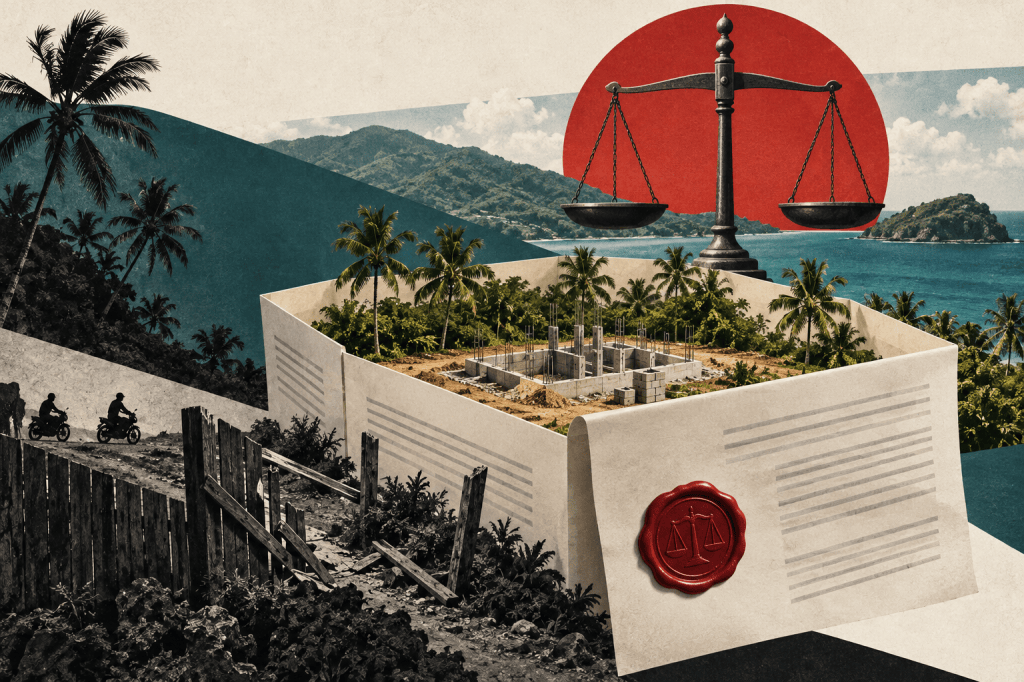
A few months ago, a group of machete-armed motorcyclists arrived at one corner of our construction site on the Samaná Peninsula. They claimed ownership of part of our land, overpowered our security, tore down the fencing, and tried to take control by force.
It’s a classic land-grab play. If you’re a foreign-backed developer, you look like an easy target. The expectation is that you’ll panic, pay something to make the problem go away, and move on.
We didn’t pay. Paying is the cheap and easy route, but it teaches the next group that intimidation works. We took the legal route instead, and it worked:
- The court confirmed our legal possession of the land.
- The police intervened and removed the invaders.
- Arrest warrants were issued for everyone involved.
Watch what happened: see the video on Instagram.
I’m telling this story because it is not unique to Samaná, or even to the Dominican Republic. Land is the largest store of wealth on earth, and wherever ownership is hard to prove, someone will try to exploit that.
Why frontier markets are the natural hunting ground
The root of the problem is documentation. The World Bank’s land team said earlier this year that only about 35% of land rights worldwide are formally documented, and that registered land is worth roughly 30% more than unregistered land. In many developing economies the share of unregistered land is far higher. Researchers who studied Sub-Saharan Africa estimate that around 86% of rural plots there have no formal registration.
Where ownership rests on informal arrangements, old paper records, or the word of a local “owner”, three things happen:
- Competing claims appear. The same parcel can be “sold” to several buyers, or claimed by heirs, neighbours and speculators who all hold some piece of paper.
- Intimidation becomes a business model. Professional land invaders occupy a plot, build a shack or two, and wait for a payout. Dominican public figures, including a former Central Bank governor, have publicly warned that organised land invasions are scaring off tourism investors and blocking projects.
- Foreign money gets targeted. Outsiders are assumed to be wealthy, unfamiliar with local procedure, and eager to avoid a fight.
I have seen versions of this in Africa and in the Caribbean. The details change. The pattern doesn’t.
Developed markets are not immune
It is tempting to think this is a “those countries” problem. It isn’t. The tactics are different, but the target is the same: the gap between who legally owns a property and who can convincingly pretend to.
- United States. The FBI’s Internet Crime Complaint Center logged 12,368 real estate fraud complaints in 2025 with reported losses of about $275 million, up from roughly $173 million the year before. Americans over 60 filed about a fifth of the complaints but suffered close to half the losses. Much of it is impersonation, spoofed emails and fake wire instructions, and investigators say AI is making the deception harder to spot.
- United Kingdom. HM Land Registry reports that it blocked more than £59 million of fraudulent applications in a single year. Criminals impersonate owners and go after properties that are empty, mortgage-free or rented out, because nobody is watching the title. Yet only around 3% of households have signed up to the Registry’s free alert service.
Different continents, same logic. The thief looks for the owner who isn’t paying attention.
What the two worlds have in common
In a frontier market the fraud usually arrives with machetes and motorcycles. In a developed market it arrives as a convincing email. In both cases:
- The victim is someone who assumed the system would protect them automatically.
- The damage is far larger than the cost of prevention.
- The winners are the owners who documented early, verified everything, and acted through the proper channels the moment something looked wrong.
What I took from it
- The Dominican legal system works if you respect it and follow due process. It isn’t always fast, but it delivers when your paperwork and procedures are sound.
- Never give in to extortion. “Just pay and move on” feels practical in the moment, and it costs far more over time.
- Surround yourself with people who know the terrain. Property rights, title, possession and enforcement are different things. You need someone who understands all of them before a problem shows up, not after.
That third point is where this case was won. Our legal team did the work: documenting possession, filing correctly, pushing the process, and staying calm when the situation on the ground was anything but. Their professionalism made the difference, and I’m grateful to every one of them.
If you’re buying or building here
Many foreign buyers only discover how much this matters when something goes wrong. A clean title search, a properly structured purchase, and a lawyer who knows the local courts are far cheaper than a crisis. If you’re buying land or building in the Dominican Republic, that’s the part I’d least want you to skip. For those who want to talk it through, our team at Samana Legal is there to help.
This wasn’t only about our land. It was about setting a precedent and protecting the integrity of development in this region. Do it properly, respect the process, and it holds.


Leave a Reply